

Six Empty Nails on My Photo Wall, and a Little Frame That Picks Up
A retired post office clerk with six grandchildren in three states, a hallway of old black-and-white frames and a neighbor whose frame answers on its own. The price, the monthly fee and the return rules, read honestly.
On the second Sunday of January, my phone rang at a quarter past four. It was my daughter Julie in Portland, Oregon, and she put my grandson on.
"Hi, Grandma," he said, and I said, "Hi, Eli, honey." Except Eli lives in Atlanta, and the boy on the phone was Theo.
 Wall No. 1 · The Six Nails

Theo is nine. He was very nice about it, the way nine-year-olds are when they've decided you're old.
"It's Theo, Grandma," he said, and then he told me about a science project with a potato and two wires.
I listened to every word, and I didn't hear any of it, because I was busy being embarrassed.
When I hung up I walked down the hallway to the wall. That's where I go when I need to think, the way some women go to the kitchen sink.
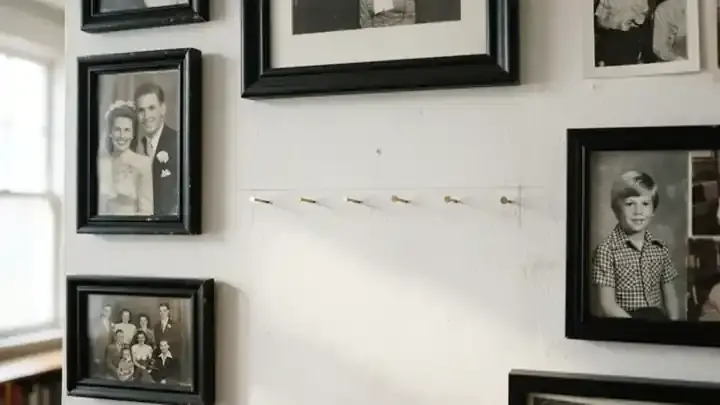
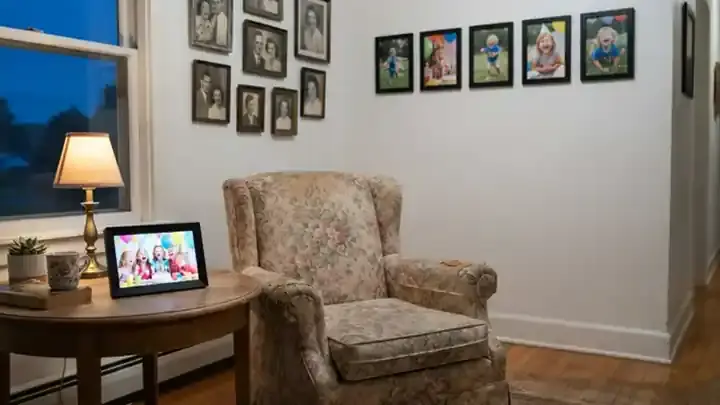
My hallway wall has twenty-two frames on it. My parents' wedding in 1948, my own in 1977, three children in braces and caps and gowns, the dog we had for fourteen years.
And in the middle, in a straight row my husband Merle measured with a level in 2015, six nails with nothing on them.
There's one nail for each grandchild now, and not one current picture to hang.
I stood there and counted them, the way I used to count the drawer at the end of a shift.
Six nails, six faces I mostly see on other people's phones, and one name I'd just gotten wrong.
This is a column about that wall.
It's about a neighbor across the street, a small black frame on her side table and a phone call I watched connect while she didn't lift a finger.
It's also about a monthly fee, because nobody else seems willing to put the monthly fee in the first paragraph. I'll put it in the fourth:
the frame is $179, and the video calls need a $9.95-a-month membership after the first 35 days.
If you've ever called one grandchild by another's name, you already know most of what follows.
If you've ever paid for a gadget and then found the fee in the fine print, you'll like the rest of it.
Thirty-Four Years Behind a Post Office Window
I worked the counter at the post office on North Main in Hutchinson, Kansas, from 1981 until the spring of 2015.
Window number two, the one by the stamp machine that always jammed.
I sold stamps, weighed packages, held mail for people on vacation and learned the handwriting of half the county. I could tell you who was writing to whom by the envelopes alone.

In those years grandmothers mailed photographs. Every December the counter filled with flat brown envelopes marked PHOTOS — DO NOT BEND in somebody's careful capitals.
I knew what was inside every one of them. School pictures, new babies on blankets, a boy holding a fish too small to keep.
My own children mailed me pictures, too, for a while. Julie sent the school photos from Portland in a padded envelope every fall, and I'd hang them the same afternoon.
Then, somewhere around 2012, the envelopes stopped. Not just mine; I watched it happen at the window, a few fewer every December, until the PHOTOS stamp in our drawer dried out.
Nobody stopped taking pictures. They just stopped printing them, because the pictures lived on the phones now, thousands of them, and a phone doesn't need a nail.
That's when Merle put up the six nails. He said, "If they won't mail them, we'll print them ourselves," and he bought a little photo printer at the Walmart on 17th Avenue.
We printed exactly four pictures with it before the ink dried up.
Merle died in the fall of 2021, and the printer is still in the hall closet, and the nails are still bare.
How Merle Hung a Wall, and Why He Left Six Nails
Merle was a lineman for the electric co-op for thirty-eight years. He climbed poles in ice storms, and he believed anything worth hanging was worth hanging level.
The hallway wall was his project the winter he retired, in 2015.
He took every photo out of every drawer, laid them on the living room carpet and moved them around for three evenings like a man playing checkers.
He hung the oldest ones at the far end, by the window, my parents and his, in their stiff wedding clothes.
Then our wedding, then the children, in the order they arrived, so the wall reads like a book from the window to the kitchen.
When he got to the end of the children, he stopped and measured out six more spaces.
We had exactly two grandchildren then, the twins, and Merle said, "There'll be more," and drove six nails with six taps each.
I said, "Merle, we don't have pictures of them." He said, "We will," and went to the Walmart for the printer the next morning.
He was right about almost everything, and wrong about that one.
The pictures never came the way they used to, and after he died I couldn't bring myself to take the nails down.
So for six years I walked past them twice a day.
They were the last thing Merle hung, and they were empty, and I'll admit that some evenings it felt like the wall was waiting for something I didn't know how to do.
Six Grandchildren, Three States and One Wall
Let me introduce my six, because I'll be talking about them, and I'd like you to know which one is which. You'll see why that matters to me.
Julie is my oldest, a dental hygienist in Portland, Oregon. Her two are Theo, nine, the potato scientist, and Maisie, six, who sings everything she says.
Daniel is my middle one, an electrician in Atlanta, Georgia. His are the twins, Ava and Eli, fourteen, who talk to me mostly in thumbs-up emojis.
Kate is my youngest, a teacher in Duluth, Minnesota. She has Rosie, four, and baby Sam, who turned one in August and whom I have held exactly twice.
That's 1,800 miles to Portland, 850 to Atlanta and 650 to Duluth. I used to know every ZIP code in Reno County, and now I know three far-away ones by heart.
On the refrigerator there's a map of the United States from a church calendar. Three magnets, one on each city, and I touch them sometimes when I'm getting the milk.
The grandchildren come in summer, one family at a time, if the flights work out.
At Christmas we do a video call on somebody's phone, which means I see the ceiling of a kitchen in Atlanta and half of a twin.
So when I say I called Theo "Eli," please understand it wasn't that I don't love them.
It's that a nine-year-old changes every three months, and I'd last seen his face clearly in July.
What a Postal Clerk Does With a Problem
At the post office we had a daybook for everything. Packages held, change of address, the jammed stamp machine, the dog on Walnut Street that bit the carrier.
If you can't count it, you can't run the counter, our postmaster used to say.
So after the Theo call, I got a spiral notebook out of the kitchen drawer and started a daybook for my wall.
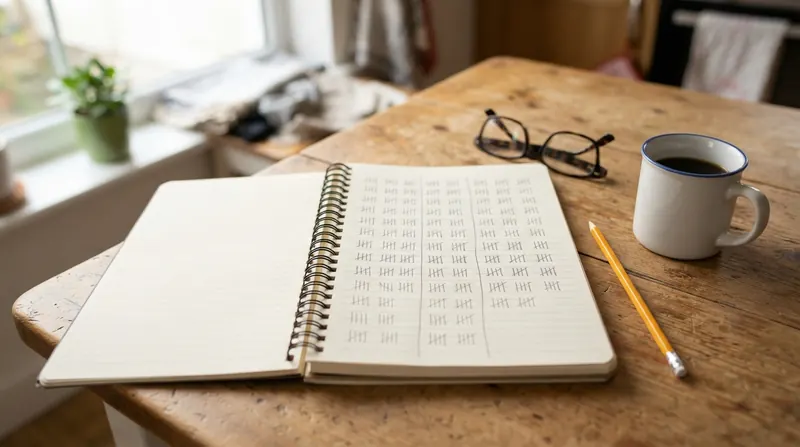
I wrote three columns across the top. Faces: how many times in a week I actually saw a grandchild's face moving and talking, not a photo on a card.
Missed: how many calls I missed, or answered too late, or answered with the camera pointing at my ear. And Names: how many times I said the wrong one.
The first week of February, I wrote it all down honestly. Faces, one, a twelve-second clip of Maisie singing that Julie texted me; missed, three; names, two.
The second week was worse.
Daniel tried to call me on the tablet he gave me two Christmases ago, and the tablet was in the junk drawer under the batteries, dead as a doornail.

I want to be fair to the tablet.
It is a perfectly good machine, and I am a perfectly capable woman who ran a federal cash drawer for thirty-four years.
But to answer a call on it, you have to have it charged, have it nearby, hear it ring, type in the code, find the green circle and hold it up so they see you and not the light fixture.
That's six steps, and I'd usually lose them at step two.
By the end of February my daybook said: faces, four in a month; missed, eleven; names, five. That included calling baby Sam "Rosie," which Kate thought was hilarious and I did not.
Four faces in a month. I had six grandchildren, and I saw a moving, talking face of one of them about once a week, usually by accident.
I'm not telling you this to be sad. I'm telling you because I think a lot of grandmothers keep the same daybook in their heads, without the columns.
Tuesday Coffee at Vera's, and a Frame That Rang
Vera Langston lives in the yellow house across the street.
She ran the cafeteria at the elementary school for twenty-six years, and she still makes coffee for eight people even when it's just the two of us.
We have coffee on Tuesdays at ten, at her house in winter and on my porch in summer.
That's been the arrangement since Merle died, and neither of us has ever missed one without a phone call.
On the last Tuesday of February, I was sitting on Vera's davenport with a cup of her coffee and a piece of her coffee cake.
And a little black frame on her side table started to chime.
It was a frame I'd seen there for months without thinking about it. I'd assumed it was one of those picture frames that shows a slideshow of the grandchildren, which it does.
But this time the slideshow stopped, and a boy's face filled the frame. It was her grandson Caleb in Denver, in a hockey jersey, saying, "Grandma, Grandma, we won."
Vera didn't move. She didn't pick anything up, didn't press anything, didn't look for her glasses; she just turned on the davenport and said, "Well, tell me about it."
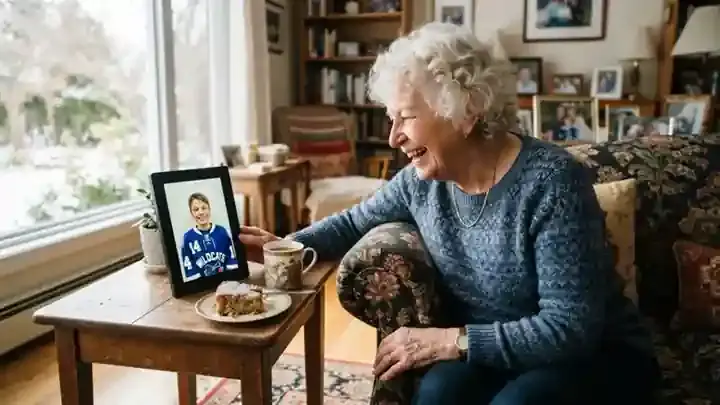
They talked for six minutes. I know because I looked at the clock on her stove, the way I used to time the line at the window.
Caleb showed her the trophy and his missing tooth and the dog. Then he said, "Bye, Grandma," and the screen went back to a photo of Vera's late husband holding a catfish.
I put my cup down. "Vera," I said, "did that thing just answer itself?"
"It does that," she said, "for the people Tommy put on the list." Tommy is her son, the one in Denver, an accountant who does everything in spreadsheets.
I asked her how much it cost, because I'm a postal clerk and that's the second question we ask. The first is "Is it fragile?"
She said, "The frame was under two hundred.
And there's a monthly thing for the calls, about ten dollars, and Tommy pays that, and if I stopped it the pictures would still come but the calls wouldn't."
That was the most honest sales pitch I'd ever heard, and it wasn't a sales pitch.
It was Vera, with coffee cake on her fork, telling me exactly what the catch was before I asked.
You left your gloves on my davenport, and you went quiet after Caleb called. You ok?
7:12I'm fine. I'm thinking about my six nails.
7:20Ha. Want me to have Tommy text Julie the name of it?
7:21Just write it on a card for me. I want to read their page myself first.
7:24That's the post office in you. Gloves are on my porch rail.
7:25Vera Wrote It Down, and I Went Home to Read
The next morning there was an index card in my mailbox, in Vera's cafeteria handwriting, the kind that used to label the Jell-O. It said VIEWCLIX, and underneath, "the little one, 10."
I'm not a computer person, but I can read a web page as carefully as I used to read a customs form.
So that's what I did, at my kitchen table, with a pencil and the daybook.
I'm going to walk you through what the seller's page says, line by line, the way I'd walk a customer through a certified mail slip.
Where they say something nicely, I'll tell you; where the fine print matters, I'll tell you that too.
I'll also tell you what I'm not going to say. This frame isn't a medical device, the seller doesn't say it is, and it doesn't do anything inside anybody's head.
What it does is put faces on a wall. For a woman with six bare nails, that turned out to be the whole question.
The Seller's Page, Read Like a Certified Mail Slip
Line one: the name and the size. The one Vera has is the ViewClix 10/e, a frame with a 10.1-inch screen, measured diagonally the way they measure televisions.
The page gives the whole frame as 10.2 inches wide, 7 inches tall and 1.2 inches deep.
That's a little smaller than a sheet of typing paper turned sideways, and the screen is 1280 by 800 pixels, which I had to look up and which means sharp enough for a face.
There's a bigger one, the 15/e, with a 15.6-inch screen.
The seller says both sizes have the same features, and suggests the bigger one if you'll be looking at it from across the room.
The small one, the page says, is "a good fit for close-up viewing and a smaller upfront budget." That described my side table by the armchair and my checkbook equally well.
Line two: the price. The page shows a regular price of $199 and a sale price of $179, labeled "frame price."
I want you to notice that little label, because the seller put it there on purpose.
Frame price means the frame, and the calls are a separate line.
Line three: the membership. Here is the sentence, copied exactly, because this is the sentence I'd want somebody to read to me:
"35 days of Premier included. Then $9.95/month, automatically renewing unless canceled."
"Video calling requires Premier."
"Photo sharing and Sticky Notes remain if you cancel."
— ViewClix product page, October 2026, The membership line, printed under the price
I read that three times. Then I wrote it in the daybook in plain postal English:
the first 35 days of calls come with the frame, and after that it's $9.95 a month, every month, until somebody cancels.
If nobody cancels, it keeps going; that's what "automatically renewing" means.
The FAQ on the same page says you cancel it in Account settings, which in my family means Julie, because she'll be the one holding the account.
And if it's canceled, here's what stays: family photos still arrive on the frame, and so do Sticky Notes, which are little typed messages the family can send to the screen.
What stops is the video calling and the other Premier features.
The page lists those other features plainly. PhotoChat, which means bringing a photo into a video call and talking about it together; group calls; videos the family sends;
and something called a Day Clock, which puts the time and date on the screen.
So there are really two frames in one box. A photo frame you buy once, and a calling frame you rent by the month.
Line four: the requirements. The page is direct about this, which I appreciated: "Plan for reliable Wi-Fi, a nearby power outlet, and a family member or helper for initial setup."
I have Wi-Fi, because Daniel made me get it in 2022 for the tablet, and the password is on a sticker on the fridge. I have outlets;
and I have six grandchildren, at least two of whom are fourteen and can set up anything.
The page also answers the question I'd have asked first, whether the grandmother needs a smartphone: "No smartphone is needed to enjoy the frame."
The family uses the ViewClix app or a web page to share photos and handle the settings.
Line five: the calling. This is the part that made me put my cup down at Vera's, so I read it twice as slowly.
The page says: "With automatic answering enabled, calls from approved family and friends can connect without tapping a screen or opening an app."
And in smaller type underneath, "ViewClix can automatically answer calls from approved contacts when enabled."
Those two little words, "when enabled," matter. Automatic answering is a setting somebody turns on, and the calls it answers come only from people somebody approved.
In Vera's house, Tommy keeps the list: Tommy, his wife, Caleb and Vera's sister in Wichita.
Those are the calls her frame picks up by itself, and that was the first thing I asked her about.
Line six: the return policy, which nobody reads until they need it.
I read it before I needed it, because thirty-four years at a window teaches you that the return counter is where every story ends.
The seller's return policy runs 30 days, for products bought on its own website.
You can return the frame "for a refund within 30 days of the date on your original receipt," and you start by calling or emailing them.
Now the part that matters, and it's a real one. The frame has to come back in its original packaging, in original condition, and "must not show any signs of use."
And here is their sentence about what counts as use, copied exactly: "'Signs of use' may also include using the product for making many video calls or uploading many pictures."
In other words, this is a return window for changing your mind, not a month-long tryout.
The refund is the purchase price minus the shipping, and the prepaid return label they send you comes out of the refund too, unless they waive it.
If a return doesn't meet the rules, they may still take it at their discretion, minus shipping and a restocking fee of at least $50.
I didn't love that paragraph. But I respected it, because it's printed right there, and because I'd rather read a hard rule now than find it out at the counter later.
Notice the two short clocks in that chart, because they don't line up.
The calls are included for 35 days, but the return window closes at 30, and it only applies if you haven't used the frame much.
So my rule, written in the daybook, was simple.
Decide whether you want it before you order it, not after, because the trial is for getting used to the calls, not for testing whether to keep the frame.
Line seven: the warranty.
The frame's hardware has a one-year limited warranty from the date of purchase, and the warranty page says it can be extended with an active Premier membership under their terms.
If it arrives broken, the return page says they'll send a replacement right away at no additional charge.
If it stops working within the warranty, they'll give you a return number, you ship it back, and they repair or replace it and pay the shipping back to you.
Line eight: shipping. ViewClix ships only to addresses in the United States, by UPS or USPS Priority Mail, from Oregon.
The product page listed shipping at no charge when I read it, with the note that it "may be available for some orders."
Priority Mail usually takes two to four business days, which, as a former employee of that service, I can tell you is an honest estimate.
Line nine: the company. The seller is ViewClix LLC, and the bottom of every page says "Built with love in Beaverton, Oregon"; the phone number is 800-304-4281, and the email is info@viewclix.com.
They don't print a street address on the pages I read, only the town.
The phone number is printed on the product page, the return page and the warranty page, which is three more places than some sellers manage.
Not a Tablet, Not a Phone, and Nobody's Watching
Before I go any further, let me clear up three things I got wrong in my head on the walk home from Vera's.
I'd guess you're getting them wrong too, because I was.
It isn't a tablet. There's no web browser, no games, no email and nothing to keep charged; it plugs into the wall like a lamp and stays there.
That was the whole problem with my tablet. A tablet asks you to do things, and the frame, as Vera put it, "just sits there being nice until somebody calls."
It isn't a phone. I can't dial out of it to call the pharmacy, and it isn't meant for that.
The calls come in from the family's app, from the people they've approved.
If I want to call Julie, I still pick up my kitchen phone, the one with the long cord Merle never let me replace.
And nobody's watching me through it. This was Vera's sister's worry, and it was mine, so I asked Vera straight out over the second cup.
She said the calls that pick up by themselves come from the people on Tommy's list, and when one does, their face fills the screen.
"It's not a camera on the wall," she said, "it's a doorbell with a face."
I'll be careful here, because I'm not an engineer. I'm only telling you what the seller's page says and what I saw:
calls from approved contacts, answered automatically if that setting is on, and photos the family sends.
And while I'm clearing things up: it isn't something that does anything for a person's mind. The seller doesn't say it does, and I won't either.
I'm a woman who called Theo "Eli" because she hadn't seen Theo's face since July. A frame can't change what's in my head;
it can only change what's on my wall and how often a face shows up on it.
Who Keeps the List, and Who Pays the $9.95
I don't make decisions about my children's money, and I don't let them make decisions about mine.
So before I ordered anything, I called a family meeting, which in our family means a group text.
I wrote it the way I'd write a notice for the lobby board. Short, with the numbers first, and no room for anybody to say I hadn't told them.
Vera across the street has a picture frame that answers video calls by itself. $179. The calls need $9.95 a month after 35 days.
2:03Mom, YES. Theo still talks about the Eli thing.
2:09I'll pay the monthly. I paid for that tablet and you never turned it on, so this is cheaper.
2:15Split it three ways. $3.32 each. I did the math.
2:16I pay for the frame, and you three sort out the $9.95. Julie keeps the list of who can call.
2:20Deal. Who's setting it up though?
2:21Twins are there for spring break on the 14th. Eli can do it in his sleep.
2:24
So that was settled in twenty-one minutes, which is a record for my family.
I'd buy the frame; the three of them would split the membership; Julie would keep the list of approved callers.
I liked that Julie kept the list. She's the oldest and the most careful, and she's the one who'd notice if somebody on it shouldn't be.
We agreed on who'd go on it the first week: my three, their spouses, the six grandchildren on their parents' phones, Vera and my sister Phyllis in Topeka.
Fifteen people, and every one of them somebody I'd open the front door for.
We also agreed on a rule that has nothing to do with the frame and everything to do with being a family.
No calls before eight in the morning Kansas time, and none after nine at night, written on the group text so nobody could claim they didn't know.
I mention that because I think it's the most useful thing in this whole column. The frame answers when someone calls; it's the family that decides when to call.
I ordered the 10/e on a Monday morning, on the seller's website, with my own card.
The order took about six minutes, which is less time than it takes to buy a money order at my old window.
It came on Thursday, by Priority Mail, in a box I could carry with one hand.
I didn't open it, because I'd promised Eli he could, and a promise to a fourteen-year-old is a contract.

The box sat on the hallway bench for nine days, right under the six nails.
Every time I walked past it, I patted it, the way you pat the hood of a car you've just bought.
A Fourteen-Year-Old, a Wi-Fi Sticker and Twenty Minutes
Daniel's twins flew into Wichita on the fourteenth of March, and I drove the hour to get them.
Ava slept the whole way home, and Eli asked me about the box four times.
We opened it at the kitchen table after supper. Eli read the setup card out loud, which he said he only did because I was watching, and he was right.
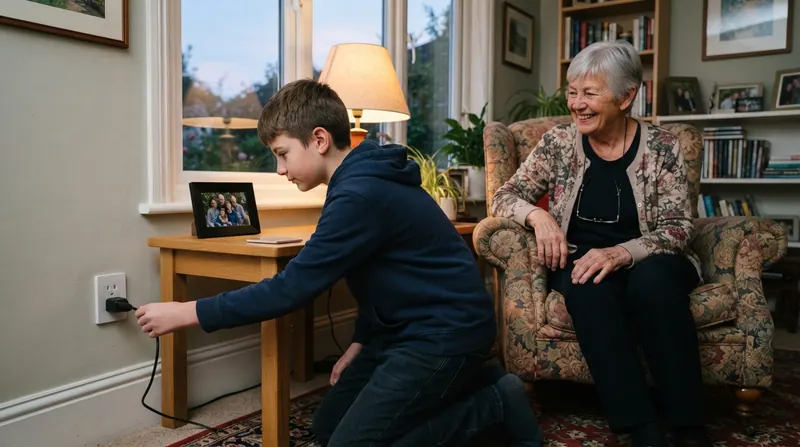
The page lists three steps, and that's how it went. Make a place for it, bring in their people, keep helping from home.
Step one took Eli about four minutes.
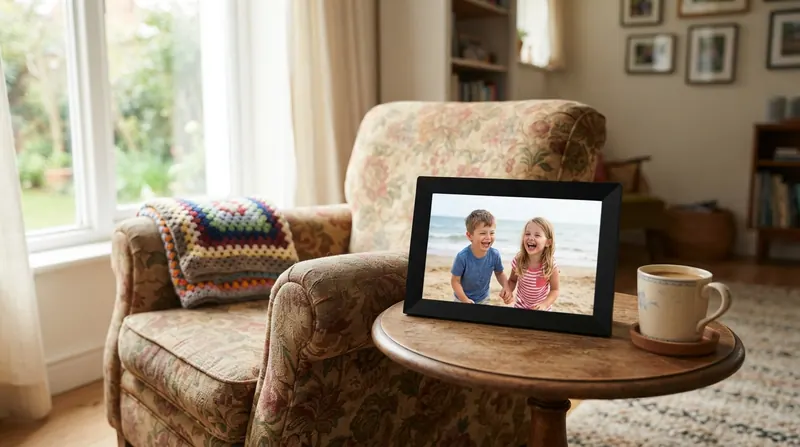
He put it on the side table next to my armchair, where I sit to read and where the light from the window comes in sideways in the afternoon.
He plugged it into the outlet behind the lamp and typed in the Wi-Fi password from the sticker on the fridge.
He told me the sticker was "a security risk," and I told him so was his grandmother.
Step two took longer, because it's the part that involves people.
Eli activated the frame on Julie's account, the way we'd agreed, and Julie, in Portland, approved the list of fifteen names on her phone while Eli watched it fill in.
Then the photos started. I don't know how else to describe it:
Julie sent four, Kate sent eleven, Daniel sent one blurry one of a dog, and they began to cycle across my side table like a slideshow at a wedding.
Theo with the potato battery, holding it up like a trophy, and Maisie in a tutu and rain boots.
Rosie asleep in a laundry basket, and baby Sam with spaghetti in his hair.
I sat in the armchair and didn't say anything for a while. Eli, to his credit, didn't say anything either;
he just went and got me a glass of water, which is something his father would never have thought to do at fourteen.
grandma its done. auto answer is on. aunt julie has the list
8:41Why are you texting me from the kitchen?
8:42so you have it in writing 😂
8:42Thank you, honey, it's beautiful. Come give me a hug in person.
8:44ok. also dad says test call in 5 min
8:44Five minutes later, the frame chimed.
And Daniel's face, from his kitchen in Atlanta, filled the screen on my side table, while I sat with my hands in my lap and didn't touch a thing.

"Hi, Mom, can you see me?" he said.
I could see him, and the twins could see him from behind my chair, and we all talked at once for ten minutes, the way families do when nobody has to hold the phone.
When he hung up, the slideshow came back.
Baby Sam and the spaghetti, then my parents' wedding photo, which Julie had scanned and added as a joke, then Theo and the potato again.
Eli said, "See, nothing to it," and went to bed. I stayed up until eleven watching photos go by, which I hadn't done since the slide projector broke in 1994.
What I Did With the Empty Row
The next morning I did something I'd been meaning to do for nine years.
I went to the hall closet, got out Merle's little photo printer, and threw away the dried-out ink.
Then I asked Kate, who is the organized one, to pick one current photo of each grandchild and send them to the photo kiosk at the grocery store on 30th Avenue.
They were ready by two o'clock, six four-by-sixes in a paper envelope.
It cost me $2.34, and I hung all six on Merle's nails that afternoon. I used the hammer he'd left on the closet shelf, right where he left it.
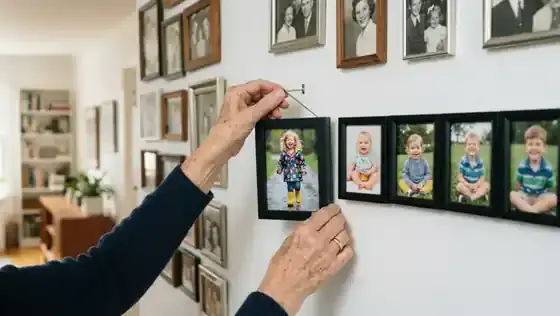
I know what you're thinking: why print photos when the frame shows them?
Because the frame is by my chair, and the wall is in the hall, and a wall is a wall.
The frame is where the grandchildren arrive. The wall is where they stay, and I wanted both, and at $2.34 I could afford both.
But I'll tell you the truth: I'd never have printed those six photos without the frame.
It took a screen on my side table, filling up with pictures I'd never seen, to make me want the nails full.
Now when Theo calls, he can see the wall behind my chair, if I turn the frame a little. And he can see himself on it, the current Theo, with the potato.
What a Day Looks Like With the Frame by the Chair
People ask me what it's like to live with the frame, as if it were a dog.
So here's an ordinary Tuesday in May, written down the way I'd write a shift report.
At seven I make coffee and sit in the armchair with the paper.
The frame is already running the slideshow, and the first picture of the day is usually whatever Kate sent the night before.
That Tuesday it was Rosie in a cardboard box she'd decided was a boat.
I looked at it for a long time, and I said "Ahoy" out loud to an empty living room, which I'm only a little embarrassed to report.
At eight-fifteen, a Sticky Note came up from Julie. It said, "Theo's spelling test today, he's nervous," so I knew what to ask about when he called.
At ten I crossed the street for coffee with Vera, the way I always do. The frame doesn't change that, and I wouldn't let it.
At noon I ate lunch at the kitchen table, out of sight of the frame, because I like my lunch in peace.
The photos kept going without me, which is what photos are for.
At three-forty the frame chimed, and it was Theo, home from school. "I got nineteen out of twenty," he said, and I said, "Which one did you miss?"
and he told me, and we spelled it together twice.
At five-thirty Daniel called from his truck, which I've asked him not to do, and he showed me a sunset in Georgia for eleven seconds.
Then he said he loved me and hung up, which is how Daniel has ended every phone call since 1992.
At seven Kate called with the baby on her hip.
Sam doesn't talk yet, but he has learned to slap the screen of his mother's phone when he sees me, and I have decided to take that as a compliment.
At nine I turned off the lamp, and the frame kept showing photos in the dark for a little while.
Rosie in the boat came around one more time, and I said goodnight to her, and went to bed.
That's it: four calls, one Sticky Note and perhaps two hundred photos going by. Nobody's life changed that Tuesday, and that is exactly what I like about it.
What Other Buyers Wrote, and Why I Won't Print It
I'm one grandmother with one daybook. So I did what I'd do with any purchase: I went looking for what other people had said about the same frame.
ViewClix has a reviews page, and there are real words from real families on it. I read a good many of them over two evenings.
But here's the honest problem.
The reviews on that page are about ViewClix frames in general, and I couldn't tell which ones were written about this small 10/e and which were about a bigger model or an older one.
So I'm not going to quote them here.
I won't put somebody's sentence about a different frame under a picture of this one, the same way I'd never put a stamp from one envelope on another.
If you want to read them, they're on the seller's website, and you can judge them yourself.
The words on this page are mine and my family's, and the family's are composites, the way this column has always been written.
What I can give you is what happened in my house, written in my daybook, with the same three columns as February.
I'll show you the bad weeks along with the good ones.
Before the daybook, the money, because the money comes first at any counter.
That chart is just arithmetic from the seller's two prices, done the way I'd do it on the back of a receipt.
The frame is $179 once.
If the family keeps the calls on, it's about $109 more in the first year, because the first 35 days are included, and about $119 a year after that.
So the honest first-year number is about $288, and about $408 by the end of year two.
Split three ways between my children, the monthly part comes to $3.32 each, which Kate reminds everyone of at least once a month.
I put it in the daybook next to what we'd already spent trying to see each other. The tablet Daniel bought me, about $300 two Christmases ago;
the photo printer Merle bought, $89 and four prints.
I'm not saying the frame is cheap.
I'm saying I finally knew exactly what it cost, in writing, before anybody spent a dime, and that's the kind of purchase I can live with.
What the Grandchildren Said About Grandma's Frame
I asked each of the six what they thought of the frame, which is a dangerous thing to ask grandchildren.
Here are their answers, written down within the hour, so I'd get them right.
Theo, nine: "It's like you're a TV channel, Grandma." I've decided that's a compliment, and I've told the ladies at church I'm on television.
Maisie, six, sang her answer, as she does everything. The words were "Grandma's in the frame, Grandma's in the frame," to a tune I believe was her own.
Ava, fourteen, said, "It's actually kind of nice that you don't have to do anything." From a fourteen-year-old, that's a standing ovation.
Eli, fourteen, the one who set it up, said, "Told you it'd be easy." He has said it every time we've talked since March, and he's earned it.
Rosie, four, wanted to know whether I live inside the frame. Kate told her no, that Grandma lives in Kansas, and Rosie said, "Then who's in the frame?"
And Sam, one, slapped the screen and laughed. I count that as the best review of the six.
I'm putting these here because they're the only reviews I can honestly vouch for.
They're about this frame, in this house, from people I'd know anywhere, and as you can see, not one of them is about anybody's head.
Twelve Weeks of Faces, Missed Calls and Names
Lorna's daybook, March to June
- Week 1Faces, 9. Eli set it up; Daniel's test call; Julie and Kate called the next two nights. Kate sent a Sticky Note that said "Love you, Mom" and I left it up all day.
- Week 2Faces, 6. One call at 7:40 a.m. that the frame answered while I was in my bathrobe at the stove. Daniel saw my curlers. Group text rule repeated in capitals.
- Week 3Faces, 3. The Wi-Fi went out for two days when I unplugged the router to vacuum. Photos stopped, calls stopped. Called Eli; he talked me through plugging it back in.
- Week 5Faces, 11. Rosie showed me every one of her stuffed animals by name, twenty-two of them. I wrote all twenty-two in the margin.
- Week 6Faces, 12. Names, 0. The 35 days ran out; Premier started at $9.95. Kate texted "$3.32" to the group, as promised.
- Week 8Faces, 4. A slow week: Julie's family on vacation, Daniel working nights. The slideshow kept going. I missed them anyway.
- Week 12Faces, 10. Called Theo "Theo" on the first try, every call for a month. Didn't make a fuss about it. Wrote it down anyway.
Look at week two before you look at anything else, because it's the week a lot of people would quit.
The frame did exactly what it was supposed to do, and that was the problem.
Daniel called at 7:40 in the morning, Kansas time, which was 8:40 in Atlanta. So he was wide awake, and he had no excuse.
The frame answered, because that's what it does for approved callers.
And there I was at the stove in my bathrobe and curlers, holding a spatula, and my son laughing so hard the twins came to see.
That's not a flaw in the machine; that's the deal you make with automatic answering.
The person calling decides when the call connects, so the family has to decide together when to call.
I sent the group text again, the one with the hours, this time in capital letters. NO CALLS BEFORE EIGHT, KANSAS TIME, I HAVE CURLERS.
Week three was my own doing.
I unplugged the router behind the television to plug in the vacuum, forgot to plug it back in, and for two days the frame sat there showing the same photo of baby Sam.
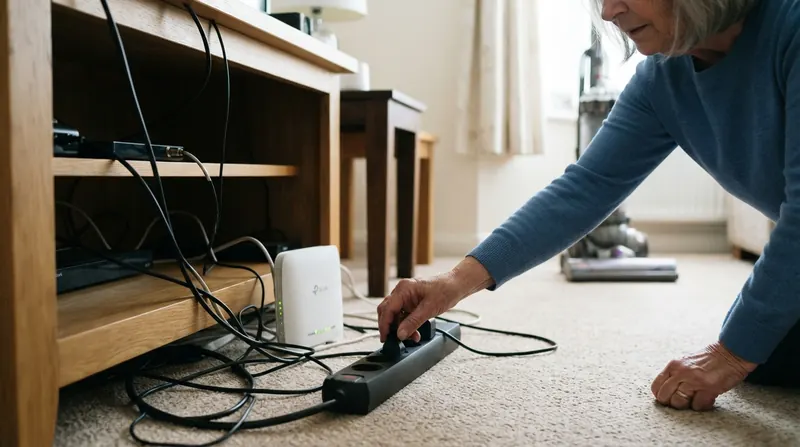
No Wi-Fi, no new photos and no calls; that's in the requirements, and now it's in my daybook too.
Eli talked me through it on the kitchen phone, the one with the long cord, which I found satisfying.
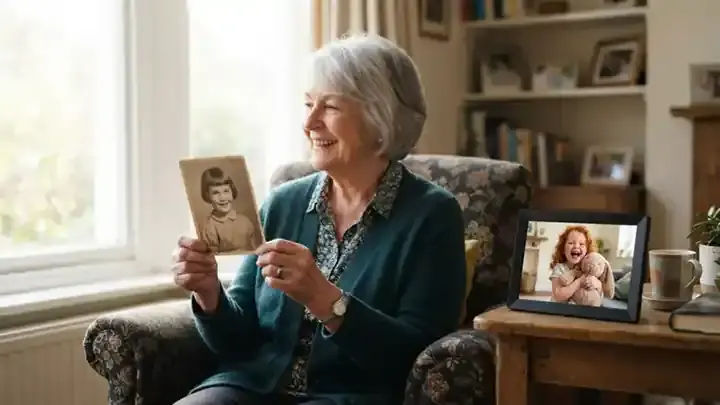
Week six is where the included 35 days ran out and the $9.95 started. Nothing changed on the frame;
the calls kept coming, and Kate texted "$3.32" to the group within the hour.
I want to be honest about week eight, too. Julie's family went to the coast, Daniel worked nights all week, and Kate's school had its spring program.
Four faces that week, and I missed every one of them more than I had in February.
A frame can't make a busy family less busy, and it can't make a quiet house less quiet on a quiet week.
But even in week eight, the photos kept arriving.
Kate sent nineteen pictures from the spring program, every one of them slightly blurry, and I watched all nineteen go by from the armchair.
And then week twelve, which I'll describe carefully. I called Theo "Theo" on the first try, every call that month.
I don't think anything happened in my head.
What happened is that his face had been on my side table every day for three months, and on my hallway wall, and I'd seen him talk about his potato in real time instead of hearing about it secondhand.
You know a person's name when you see their face often enough. That isn't science, and the seller doesn't claim it; it's just being a grandmother with the faces in the room.
Forty-one faces in a month instead of four. That's the only number in this column I'd underline, and it's a number about my family, not about a frame.
The frame didn't call anybody. My children and grandchildren did; the frame just took away the six steps between their call and my face.
What Readers Wrote About the Six Nails
When the church newsletter ran a short version of this story in July, the mail came in the old-fashioned way and the new one.
Here are some of the comments, shown the way they'd look online.
Celia's comment is the one I'd underline. Read the return page before you order, because the 30-day window is for changing your mind, not for a month of heavy use.
And Marvin's is the one that made me smile, "I still don't like the word smart on a frame." Neither do I, Marvin; I call it the frame by my chair.
The comments above are illustrative, written from the letters and messages readers sent. Names and small details are changed, the way they always are on this desk.
Two Neighbors, Two Frames and a Tape Recorder
In June, the church newsletter asked Vera and me to record a little conversation for their audio page.
Vera's granddaughter set up a phone on the porch rail and told us to "just talk normal," which is impossible once someone says that.

Porch Talk · The Hutchinson Tapes, Episode 4
Two Neighbors, Six Nails and a Frame That Picks Up
Lorna
host
Vera, the newsletter wants to know why you had that frame on your side table for eight months and never once mentioned it answers by itself.
 Vera
guest
Because nobody asked, and you thought it was a picture frame. It is one; it just also lets Caleb tell me about hockey without me finding my glasses.
Lorna
host
Tell them about the monthly fee. You were the first person who ever told me the catch before I asked.
Vera
guest
It's about ten dollars a month for the calls after the first month or so, and Tommy pays it. If he stopped, the pictures would still come, and I'd rather know that than find it on a bill.
Lorna
host
What's the thing you'd tell somebody who's thinking about one?
Vera
guest
Decide who's on the list, and decide when they can call. The frame doesn't know you're in your curlers, Lorna.
Lorna
host
And the thing you'd tell their children?
Vera
guest
Send pictures, not good pictures, any pictures; a blurry one of the dog is better than nothing on a Tuesday. And call on the days nothing happened, not just the days somebody won.
Lorna
host
And what would you tell somebody who's nervous about a camera in the living room?
Vera
guest
I'd tell her to ask who's on the list, and to put herself in charge of the list if she wants to be. Tommy shows me mine every Christmas, and I've never once wanted somebody off it.
I've listened to that tape four times.
"Call on the days nothing happened" is the best advice anybody's given my children, and it came from a cafeteria manager with coffee cake on her fork.
That's the thing nobody puts in the ads. The frame is just the doorbell; the family still has to ring it.
How I'd Order It, If I Were Ordering Again
If you're a grandmother reading this, or a daughter reading it for her mother, here's what I'd do, in the order I'd do it.
It's the same list I gave Arlene for her eight empty nails.
First, call a family meeting, even if it's a group text. Decide who pays for the frame, who pays the monthly part and who keeps the list of approved callers.
Second, decide the hours. Write them down where everybody can see them, because automatic answering is wonderful at 4:15 on a Sunday and less wonderful at 7:40 on a Tuesday.
Third, check the Wi-Fi and the outlet where the chair is, not where the router is. The frame lives where the person sits, and it needs both.
Fourth, line up the helper. A grandchild, a neighbor's son, a daughter on a visit; the page says plainly that the first setup needs somebody.
Fifth, read the return page before you order.
Thirty days, original packaging, no signs of use, minus the shipping and the return label.
The 10.1-inch frame · read the membership and return lines before ordering
The Policy, Read Like a Window Clerk
Now the part most columns skip, and the part I'd have read first. What happens if it isn't for you, or if something goes wrong.
The ViewClix return policy and warranty, in plain words
"You can return it for a refund within 30 days of the date on your original receipt."
That is the seller's own sentence, from its 30-day return policy for products bought on viewclix.com, read in October 2026; the frame must come back in its original packaging with no signs of use, which the policy says may include many video calls or many uploaded pictures. The refund is the purchase price less shipping and the return label, and the hardware carries a one-year limited warranty · ViewClix LLC · Beaverton, Oregon · 800-304-4281 · help@viewclix.com
Thirty days is a short window, and it has a real condition.
The frame has to come back looking like it never left the box, so this is the policy for "I changed my mind," not "I tried it for a month."
The words "less the shipping" matter. The refund doesn't include what you paid to ship it, and the prepaid return label they send is deducted too, unless they decide to waive it.
If it arrives broken, that's a different counter. The policy says they'll send a replacement right away at no additional charge, and that's the sentence I'd want if a box got dropped.
If it stops working within the year, the warranty page says they'll give you a return number, you ship it back, and they repair or replace it and pay the shipping back to you.
With an active Premier membership, the warranty can be extended under their terms.
And one more line for the family member paying the monthly part.
Premier renews by itself every month until somebody cancels it in Account settings, and canceling stops the calls but keeps the photos and Sticky Notes coming.
One question I had to look for twice: is the $9.95 per frame or per family? It's per frame;
the product page says so in the small line under the second price, "then $9.95/month per frame."
Who I'd Hand My Index Card To, and Who I Wouldn't
I'd hand Vera's index card to you if:
- You have grandchildren far away and a side table near the chair where you sit every day
- Somebody in the family is happy to keep the list of callers and send photos without being asked twice
- You'd rather have calls arrive on their own than find, charge and open up a tablet
- You have Wi-Fi at home, or a family member who can arrange it
- The family can agree on $9.95 a month for calls after the first 35 days, or is content with photos alone
I'd keep the card in my purse if:
- You want a device to watch over someone; it isn't one, and the seller doesn't sell it as one
- Nobody in the family will send photos or call; the frame only shows what people send
- You don't have Wi-Fi and can't get it; nothing arrives without it
- You want to try it for a month and send it back; the return window is for unused frames
- You live outside the United States; the seller only ships to U.S. addresses
That first line on the second list matters most to me. This is a frame for faces, not a guardian; the guarding is still the family's job, and the neighbors'.
I chose the small one for two reasons. My chair is two feet from the side table, and my checkbook is the size it is.
If your mother watches from the couch across the room, or her eyes need a bigger face, the seller itself suggests the 15/e.
I haven't seen one, so I won't tell you more than that.
What It Costs Against What We'd Already Spent
I'm not saying the tablet and the printer were wasted because the frame is cheaper. I'm saying they asked me to do six things, and the frame asks me to sit down.
If the family keeps the calls on, the first year is about $288 all in, and after that about $119 a year.
If they don't, it's a $179 photo frame that never runs out of new pictures, and that's not nothing either.
Short answers to the questions Vera and I get at church
Does the grandparent need a smartphone?
No, the seller's page says no smartphone is needed to enjoy the frame. The family uses the ViewClix app or web page to share photos and manage settings; the frame needs Wi-Fi, a power outlet and a helper for the first setup.
Does it really answer by itself?
When automatic answering is enabled and Premier is active, calls from approved contacts can connect without anyone tapping the screen, according to the seller. The family decides who is approved.
What happens if we stop paying the $9.95?
Video calling and the other Premier features stop. Family photos and Sticky Notes keep arriving, according to the seller's membership line.
Is the $9.95 per family or per frame?
Per frame, according to the small line under the price on the seller's product page.
Can we try it for a month and return it?
Not really: the return policy is 30 days from the receipt date, and the frame must show no signs of use, which the policy says may include many video calls or many uploaded pictures. Read the return page before ordering.
Does it help with names or anything like that?
The seller doesn't claim it does, and neither do I; it's a frame for photos and calls. In my house it changed how often I saw the grandchildren's faces, and that's all I can tell you.
Where does it ship?
Only to addresses in the United States, by UPS or USPS Priority Mail from Oregon.
One more answer, the one I'd give across my old counter.
If the person you're buying it for has never asked for it, ask them first, and show them Vera's, or this page.
Nobody likes a surprise that rings. But almost everybody likes a picture of their grandchild with spaghetti in his hair.
ViewClix 10/e Smart Frame · Wi-Fi, an outlet and a helper for setup
P.S. The six nails are full now, with prints from the grocery store kiosk at $2.34 for six, and the frame by my chair keeps them current; if you have a row of empty nails in your house, send your children this page and let them read the monthly line first.
P.P.S. Remember what Vera said on the porch, to call on the days nothing happened; the frame only answers, and the family has to ring.
The full guide to the frame, the membership and the advertising around it is linked at the foot of this page.
First, the people: Lorna Haskell is a pen name. Vera, Julie, Daniel, Kate and the six grandchildren are composites, the way family columns have always been written.
Everything about the frame itself comes from the seller's own pages, read in October 2026. That means its price, its monthly membership, its return policy, its shipping rules and its warranty.